

The market for pocket-sized stabilized cameras has reached a critical turning point. For years, one brand dominated the landscape with monolithic designs that consolidated the camera, sensor, and physical gimbal into a single, non-detachable stick. However, the introduction of modular, detachable pocket gimbals like the Hohem Eyepic has challenged this architectural standard. Creators are no longer asking if a pocket gimbal is stable, but whether its form factor can adapt to highly dynamic, off-body mounting scenarios without compromising raw optical performance.
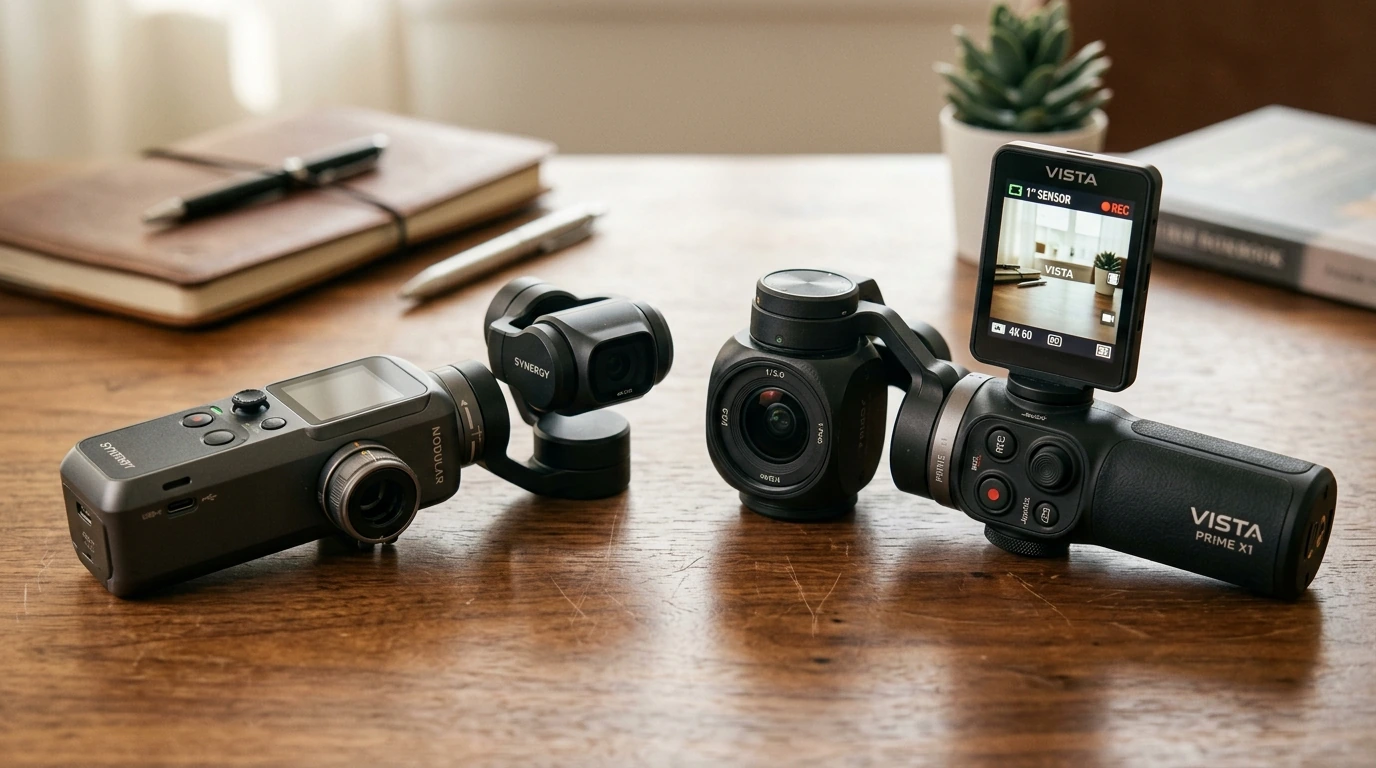
- Structural Modularity: The Hohem Eyepic features a detachable camera module, allowing it to act as both a wearable camera and a traditional handheld gimbal.
- Sensor Capabilities: DJI's Osmo Pocket 3 dominates in raw image quality, utilizing a massive 1-inch CMOS sensor that vastly outperforms the Eyepic in low-light and high-dynamic-range scenarios.
- Stabilization Physics: Both utilize physical 3-axis mechanical stabilization, but DJI offers higher torque motors capable of resisting wind resistance at higher velocities.
- Target Audience: Choose the Hohem Eyepic for extreme mounting versatility and budget-conscious multi-angle setups; choose DJI for high-end cinematic production and reliable night shooting.
The Architectural Divide: Modular vs. Monolithic
To understand whether the Hohem Eyepic is truly better than its DJI counterparts, we must analyze the core engineering differences between their designs. Pocket gimbals must balance thermal dissipation, physical weight, battery distribution, and mechanical leverage.
DJI's Osmo Pocket series employs a monolithic structural design. The camera head, mechanical motors, processing unit, and battery exist in a fixed, unified column. This maximizes electrical signal integrity and allows for highly efficient thermal copper heat-pipes to run from the sensor down to the handle. It is an optimized, highly refined platform built around an exceptionally large sensor.
In contrast, the Hohem Eyepic represents a modular approach. By engineering a detachable camera head that can separate from the battery-laden control grip, Hohem solves a major friction point: physical placement. When detached, the camera head is light enough to be clipped onto clothing, magnetic mounts, or vehicle surfaces, communicating wirelessly or via ultra-thin ribbons to the main controller. However, this split-chassis design introduces distinct engineering trade-offs regarding power transfer, latency, and thermal limits.
Detailed Side-by-Side Analysis
1. Sensor Size, Optics, and Image Processing
In optical engineering, there is no substitute for physical sensor surface area. The DJI Osmo Pocket 3 features a 1-inch CMOS sensor with a pixel size that allows for exceptional light-gathering capability. Coupled with a fast f/2.0 aperture, it produces natural optical bokeh and keeps digital noise to a minimum even at high ISO levels.
The Hohem Eyepic utilizes a smaller sensor footprint, closer to standard action-camera dimensions. While it delivers excellent clarity and vibrant colors in bright daylight, its dynamic range is narrower. In high-contrast scenes—such as shooting against a bright afternoon sky—the Eyepic is more prone to clipping highlights or losing shadow detail compared to DJI's log profiles (D-Log M 10-bit), which preserve color grading latitude for professional post-production workflows.
2. Stabilization Mechanics and Motor Torque
Both devices feature true 3-axis mechanical gimbals, which physically counteract roll, pitch, and yaw. However, the performance of these systems diverges when subjected to external physical forces, such as high wind or rapid directional changes.
DJI's brushless motors are engineered with higher torque limits. If you mount the Osmo Pocket 3 on a suction cup outside a moving car, the motors can hold their orientation against significant wind resistance. The Hohem Eyepic, because of its ultra-lightweight detachable head, uses smaller, more delicate motors. While perfectly adequate for walking, running, and typical vlogging, they may struggle and slip into a thermal shutdown or safe-mode if subjected to high wind load or extreme vibrations.
3. Usability, Software, and Ecosystem
DJI has spent years refining its ActiveTrack algorithms, and the Osmo Pocket 3 represents the pinnacle of this research. It locks onto subjects with highly sophisticated face and body detection, rarely losing tracking even if the subject turns around or is temporarily obscured.
Hohem's companion software and onboard tracking capabilities have improved immensely with their latest AI tracking modules. The Eyepic can track faces effectively for solo presentations. However, its app integration and wireless transmission latency are slightly more noticeable than DJI's seamless system. Where Hohem excels is in physical UI flexibility: the ability to control the detached camera head remotely using the handle as a wireless remote control is an incredibly creative feature that DJI cannot match natively without accessories.
Real-World Scenarios: Engineering in Action
Scenario A: The Solo Adventure Vlogger
Consider a creator hiking through a dense forest. They want to capture a mix of first-person perspective (POV) shots and third-person walking shots.
Using the Hohem Eyepic, the creator detaches the camera head and clips it magnetically to their backpack strap. They walk hands-free, capturing stable POV footage. When they see an interesting landmark, they slide the camera back onto the handle, instantly transitioning to manual tracking and pan-follows. The engineering why here is simple: modular physical design reduces the friction of changing camera angles, allowing a solo creator to get diverse shots without carrying multiple cameras.
Scenario B: The Low-Light Urban Cinematographer
Now consider a creator filming cinematic b-roll in a neon-lit city street at night.
With the DJI Osmo Pocket 3, the 1-inch sensor captures the subtle transitions of light on wet asphalt without introducing heavy chroma noise in the dark areas. Because of the high dynamic range, the bright neon signs do not blow out into pure white circles. Despite the camera being physically fixed to its handle, the raw performance of the sensor ensures that the footage is immediately usable for commercial projects. The engineering priority here is sensor physics over structural modularity.
Decision Framework: Who Should Choose What?
To finalize your choice, evaluate your workflow against these specific operational priorities:
- Choose the Hohem Eyepic if: You prioritize physical versatility, unique camera angles, wearable use cases, and require a budget-friendly creative tool that can adapt to different physical configurations without requiring expensive secondary mounts.
- Choose the DJI Osmo Pocket 3 if: Your primary concern is uncompromising image quality, professional-grade 10-bit color grading, flawless low-light performance, and the absolute reliability of high-torque stabilization in challenging environments.
Frequently Asked Questions
Can the Hohem Eyepic operate completely independent of its handle?
Yes. The detachable camera module contains a built-in auxiliary power cell and wireless transmitter. It can record directly to an internal storage medium or stream directly to your mobile device, allowing you to mount it in tight spaces where a standard gimbal handle would never fit.
Does the DJI Osmo Pocket 3 support any modular attachments?
While the DJI Osmo Pocket 3 cannot be physically split into a separate camera and handle, it does support modular expansion via its bottom USB-C port. You can attach battery handles, mechanical tripod bases, and wide-angle lens adapters. However, the camera head itself remains permanently fixed to the main control body.
Which device handles thermal dissipation better during long 4K recordings?
The DJI Osmo Pocket 3 has a larger surface area and an integrated metal heatsink frame, allowing it to dissipate heat highly effectively during continuous 4K/60fps recording. The Hohem Eyepic, due to its ultra-compact, plastic-shielded detachable head, may reach its thermal threshold faster under direct sunlight or in stagnant air environments.
link : Hohem Eyepic vs DJI Osmo Pocket 3: Which Pocket Gimbal Reigns Supreme?